

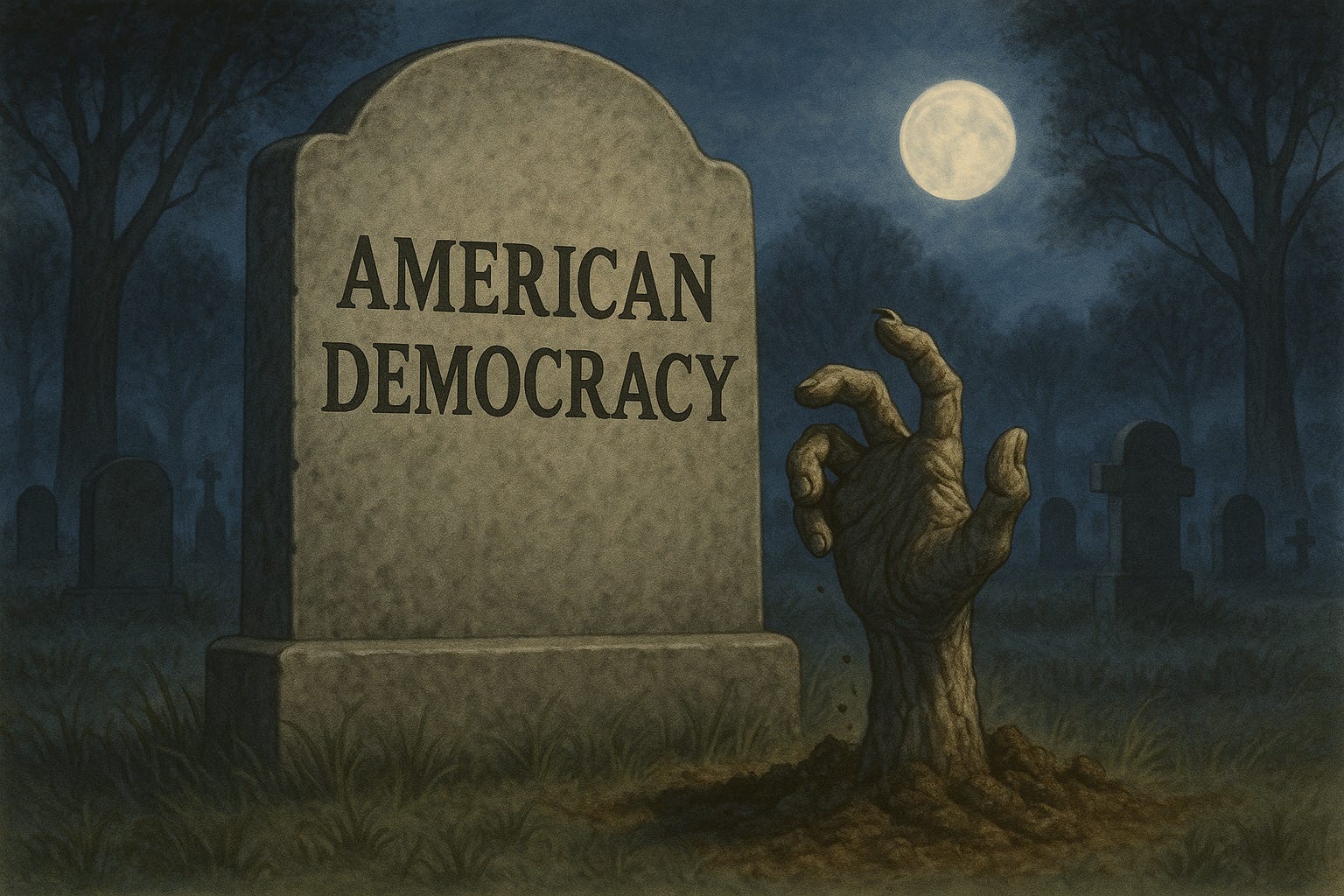
Donald Trump and the Republican Party are systematically dismantling free and fair elections in America. This is documented fact, admitted by their own officials, codified in state laws, and visible in the data. They know they cannot win majority support, so they're preventing the majority from voting. The 2028 election will be their first opportunity to deploy all these mechanisms simultaneously under a Trump administration that controls the Department of Justice, and they're not hiding their intentions. Here's exactly how they're doing it and what must be done to stop them.
On June 4, 2021, Texas Attorney General Ken Paxton made an extraordinary admission on Steve Bannon's podcast. Discussing Harris County's attempt to mail ballot applications to its 2.4 million registered voters during the pandemic, Paxton stated: "Had we not done that, we would have been in the very same situation... Donald Trump would've lost the election." This was acknowledgment from Texas's top law enforcement official that blocking expanded voting access was essential to Republican electoral success.
Paxton's candor revealed what voting rights advocates have long argued, that contemporary American elections aren't contests between candidates, but battles over who gets to participate. The machinery of voter suppression he celebrated has only grown more sophisticated since, with Texas implementing Senate Bill 1 that increased mail ballot rejections from under 1% to 12.4%. As we approach 2028, the quiet architecture of disenfranchisement threatens to transform from tactical advantage to systematic capture.
The scale of voter suppression in 2024 America defies most citizens' understanding of democratic norms. Consider what's happening in Georgia, where Senate Bill 202 has transformed the landscape of ballot access with surgical precision. Metro Atlanta's four core counties, home to 2.5 million registered voters, have seen their ballot drop boxes slashed from 107 to just 25, a 77% reduction.
Fulton County alone dropped from 38 boxes to 8. The boxes that remain are now restricted to indoor locations accessible only during business hours, typically 9 AM to 5 PM, rather than the 24/7 outdoor access available in 2020. The geographic impact is substantial, that 70% of urban and suburban voters could reach a drop box within 10 minutes in 2020 and today less than half can. Usage has correspondingly plummeted from 6.3% to under 1%. Meanwhile, conservative activists have challenged 65,000 to 80,000 voter registrations since 2022, with the state planning to purge nearly 500,000 "inactive" voters, which represents 6% of all registered Georgians. Federal oversight from the Department of Justice now monitors four metro Atlanta counties for voting rights compliance, acknowledging the discriminatory impact.
Texas presents an even starker case study in bureaucratic disenfranchisement through the implementation of Senate Bill 1. The March 2022 primary, the first statewide election under the new law, saw 24,636 mail ballots rejected, a staggering 12.4% rejection rate compared to less than 1% in 2020. County-level data reveals the geographic discrimination: Harris County rejected 19% of mail ballots, Bexar County 22%, while some rural counties maintained single-digit rates. The mechanism is deceptively simple: voters must provide an identification number on both their application and ballot envelope that precisely matches their original voter registration, which for many occurred decades ago.
The burden falls heaviest on those Texas restricts mail voting to. Citizens over 65 and disabled individuals. For example, a 92-year-old who registered in 1970 must recall which ID number she provided then; if she can't, her ballot is void. The Brennan Center found that of the 30,000 voters whose ballots or applications were rejected, 90% simply gave up rather than navigate the correction process. More tellingly, 85% of those rejected had voted consistently in 2016, 2018, and 2020.
Florida's systematic reversal of Amendment 4, which 65% of voters approved to restore voting rights to people with felony convictions, represents perhaps the most brazen nullification of popular will. The amendment would have enfranchised 1.4 million citizens. Instead, the legislature immediately passed Senate Bill 7066 requiring full payment of all fines, fees, costs, and restitution before rights restoration. Today, 964,000 Floridians remain disenfranchised, with approximately 730,000 unable to vote solely because they cannot pay what amounts to a modern poll tax.
The median debt is $667, but for people whose average annual income is less than $25,000, they may have to choose to purchase food rather than vote. Black Floridians face a 12% disenfranchisement rate, up from 6% in 1980, while comprising 48% of the state's prison population and 15% of the total population. The state has begun prosecuting returning citizens who voted after receiving official voter cards, claiming they should have known they remained ineligible, creating a climate of fear that extends suppression beyond those directly affected.
Three interconnected mechanisms threaten to transform voter suppression from tactical advantage into systematic minority rule by 2028. The first involves certification capture, which represents the most direct threat. According to States United Action's analysis, 23 election deniers now serve in statewide offices overseeing elections across 18 states, with 156 more in Congress. Citizens for Responsibility and Ethics in Washington identified 35 rogue election officials across eight states who have refused to certify election results and explicitly state they may do so again. These aren't random cranks but strategic appointments: Julie Adams and Michael Heekin on Fulton County's Board refused to certify Georgia's March 2024 primary. The infrastructure already exists, with one in five governors, one in ten secretaries of state, and almost one in five state attorneys general being election deniers.
The second mechanism involves algorithmic purging that weaponizes data science for disenfranchisement. The EagleAI Network, developed by Georgia doctor Rick Richards and promoted by Trump lawyer Cleta Mitchell, exemplifies this frontier. Unlike the legitimate Electronic Registration Information Center that nine Republican states abandoned, EagleAI scrapes public data including online obituaries rather than accessing official death records. Georgia Elections Director Blake Evans stated the system "draws inaccurate conclusions and presents them as evidence of wrongdoing." Despite these warnings, Columbia County implemented it. True the Vote challenged 317,886 voters by August 2024. Michigan State University research confirms purging disproportionately targets "underrepresented and lower-income communities."
The third element involves the systematic dismantling of legal architecture protecting voting rights. While Allen v. Milligan upheld Section 2 of the Voting Rights Act in 2023, the threat has merely shifted tactics. The 8th Circuit Court ruled there's "no private right of action" under Section 2, meaning only the Department of Justice could enforce voting rights. This would be catastrophic given that 96.4% of Section 2 claims since 1982 involved private plaintiffs. Fifteen Republican states now argue this position. As USC Law Dean Franita Tolson observed, "If there is no private right of action under Section 2, the Voting Rights Act is basically dead."
Imagine a casino where the house edge increases imperceptibly each night. The mechanism isn’t through obvious cheating, since the cards appear unchanged and the dice seem fair, but through subtle environmental manipulations. The parking lot gradually shrinks, but only on the side nearest public transportation. ATMs disappear from certain floors. Bet minimums rise unpredictably. Security begins demanding multiple forms of ID, but only from players who look a certain way. The cashier windows close earlier, though no signs announce the change. Certain players find their membership cards mysteriously invalid, requiring lengthy appeals processes that outlast their visit. No single change appears decisive. Each can be explained through neutral language: "operational efficiency," "security enhancements," "system upgrades."
Yet the cumulative effect is undeniable. Specific demographics find the casino increasingly inhospitable, their participation gradually becoming theoretical rather than practical. The house doesn't need to ban anyone explicitly; it simply makes playing the game incrementally harder for those it wishes to exclude. This is American democracy, right now. The fundamental game remains nominally unchanged since citizens cast ballots, ballots are counted, and winners take office. But the machinery surrounding that simple act has been precisely calibrated to ensure certain outcomes while maintaining plausible deniability about intent.
The strongest argument for voting restrictions centers on election integrity. The claim is that illegal voting threatens democratic legitimacy, and common-sense measures like voter ID protect the sanctity of the ballot. Trust in elections underpins peaceful transfers of power. If citizens believe fraud is rampant, democracy itself becomes unsustainable. Even rare instances of fraud, the argument goes, can shatter public confidence in electoral outcomes.
So let's examine the actual numbers. The Heritage Foundation, which advocates for voting restrictions, documented approximately 1,500 proven cases of election fraud over multiple decades. Taking their data at face value, Brookings Institution calculated fraud rates: Arizona saw 36 cases over 25 years among 42.6 million ballots cast, yielding a rate of 0.0000845%. The Brennan Center's comprehensive studies found fraud occurs between 0.0003% and 0.0025% of the time. To put this in perspective, Americans are literally more likely to be struck by lightning than to commit voter impersonation fraud.
Government investigations confirm these findings. The Department of Justice initiated just 525 election fraud investigations between 2001 and 2017 across eight federal election cycles, representing 0.02% of federal prosecutors' caseload. In 2020, despite unprecedented scrutiny, 60+ lawsuits challenging results produced exactly one minor victory involving "far too few votes to overturn results." The Department of Homeland Security and Cybersecurity and Infrastructure Security Agency declared 2020 "the most secure election in American history." Yet the measures implemented to prevent this virtually non-existent problem affect millions. Texas alone has 600,000+ registered voters lacking required ID. Nationally, 25% of Black voters, 16% of Latino voters, and 18% of seniors lack acceptable photo ID, compared to 5% of white voters. For every potentially fraudulent vote prevented, there are thousands of legitimate voters who face barriers. We're witnessing malpractice in governance that’s justified through disinformation and fear rather than reality.
The causal relationship between voting accessibility and turnout is unambiguous. Oregon, ranked most accessible, achieved 78.5% turnout in 2020 and led the nation with 66.9% in 2022 midterms. Colorado, with universal mail voting, hit 77.6% in 2020. Minnesota consistently approaches 80%. Meanwhile, Texas, ranked dead last in accessibility, managed just 56.6% turnout in 2020 and 42% in 2022, consistently placing in the bottom ten nationally. Tennessee has identified 2.3 million "missing voters" while Georgia lags accessible state averages despite mobilization efforts. The 20-point gap between Oregon and Texas isn't explained by civic engagement or demographics but by policy.
Michigan provides the natural experiment we need to understand this relationship. After passing Proposal 2 in 2022, which added nine days of early voting, permanent absentee voting, and drop boxes, turnout jumped to 74.6% in 2024, ranking third nationally. Over 60% voted early or by mail, and 820,000 first-time voters participated. The United States ranks 31st out of 35 developed democracies in voter turnout, falling behind Estonia, Slovenia, and Slovakia. Countries with automatic registration, national holidays for voting, and universal mail access consistently achieve 80% or higher participation. This is what a functioning democracy looks like.
Either we believe in democracy, as messy and frustrating as it can be, or we don't. The technical debates about signature matching and drop box hours obscure this fundamental choice. Every restriction defended as 'election integrity' is actually a confession that participation is considered dangerous. There is no middle ground or compromise with the enemies of democracy. Those who benefit from minority rule have chosen to preserve their power rather than earn it. If we don't demand a voice, then we won't have one.
For a detailed action plan on how to fight back against these attacks on voting rights, see: Republicans Broke Democracy. Here's How We Fix It."
If you enjoyed this article, you might also like:
CONSERVATISM: AMERICA’S EMPATHY DISORDER
My latest book
Get it here → https://a.co/d/2MIFIvG
References
Aleaziz, H. (2021, June 3). Paxton: Trump would've lost Texas if it hadn't blocked mail-in ballot applications being sent out. Newsweek. https://www.newsweek.com/texas-ag-says-trump-wouldve-lost-state-if-it-hadnt-blocked-mail-ballots-applications-being-1597909
American Civil Liberties Union. (2024). Voting rights. https://www.aclu.org
Brennan Center for Justice. (2017, January 31). Debunking the voter fraud myth. https://www.brennancenter.org/our-work/research-reports/debunking-voter-fraud-myth
Brennan Center for Justice. (2022). Records show massive disenfranchisement and racial disparities in 2022 Texas primary. https://www.brennancenter.org/our-work/research-reports/records-show-massive-disenfranchisement-and-racial-disparities-2022-texas
Brennan Center for Justice. (2024a). Mass voter challenges and voter list maintenance in Georgia. https://www.brennancenter.org/our-work/research-reports/mass-voter-challenges-and-voter-list-maintenance-georgia
Brennan Center for Justice. (2024b). The myth of voter fraud. https://www.brennancenter.org/issues/ensure-every-american-can-vote/vote-suppression/myth-voter-fraud
Brennan Center for Justice. (2024c, December). Voting laws roundup: 2024 in review. https://www.brennancenter.org/our-work/research-reports/voting-laws-roundup-2024-review
Brookings Institution. (2022). Widespread election fraud claims by Republicans don't match the evidence. https://www.brookings.edu/articles/widespread-election-fraud-claims-by-republicans-dont-match-the-evidence/
Campaign Legal Center. (2021). Results of lawsuits regarding the 2020 elections. https://campaignlegal.org/results-lawsuits-regarding-2020-elections
Citizens for Responsibility and Ethics in Washington. (2024). Election certification under threat. https://www.citizensforethics.org/reports-investigations/crew-reports/election-certification-under-threat/
Corasaniti, N., & Saul, S. (2022, July 27). A new Georgia voting law reduced ballot drop box access in places that used them most. NPR. https://www.npr.org/2022/07/27/1112487312/georgia-voting-law-ballot-drop-box-access
Democracy Docket. (2023). The real cost of voter ID laws — and who pays the highest price. https://www.democracydocket.com/analysis/the-real-cost-of-voter-id-laws-and-who-pays-the-highest-price/
Doubek, J. (2022, April 6). Almost 25,000 mail-in ballots were rejected in Texas for its March 1 primary election. NPR. https://www.npr.org/2022/04/06/1091267343/almost-25-000-mail-in-ballots-were-rejected-in-texas-for-its-march-1-primary-ele
Election Protection Coalition. (2024). 866-OUR-VOTE hotline. https://866ourvote.org
Heritage Foundation. (2024). Election fraud database. https://www.heritage.org/voterfraud
Hernández, A. R., & Helderman, R. S. (2024, June 4). Georgia voter registration challenges are fueled by Eagle AI. NPR. https://www.npr.org/2024/06/04/nx-s1-4991945/voter-registration-mass-challenges-georgia
League of Women Voters. (2024). Voting rights advocacy. https://www.lwv.org
Michigan Department of State. (2025, July 3). Michigan Department of State releases 2024 county-level election data showing record turnout in state's first presidential election after passage of Proposal 2022-2. https://www.michigan.gov/sos/resources/news/2025/07/03/mdos-releases-2024-election-data-showing-record-turnout-in-states-election-after-proposal-2022-2
Michigan State University. (2024, October). New MSU research sheds light on impact and bias of voter purging in Michigan. MSUToday. https://msutoday.msu.edu/news/2024/10/new-msu-research-sheds-light-on-impact-and-bias-of-voter-purging-in-michigan
Ramírez-Hernández, A. (2022, April 6). More than 12% of mail-in ballots were rejected in Texas under new GOP voting rules, final tally shows. The Texas Tribune. https://www.texastribune.org/2022/04/06/texas-mail-in-ballot-rejection-voting/
Sentencing Project. (2024). Florida bans voting rights of over 960,000 citizens. https://www.sentencingproject.org/fact-sheet/florida-bans-voting-rights-of-over-960000-citizens/
States United Democracy Center. (2024). States United Action releases post-election analysis and 2025 election denier landscape: Election deniers have fewer seats, more power in 2025. https://statesunited.org/post-election-2024/
Stimson, H. von S. (2024, January 29). Heritage Foundation election fraud database at 1,500 cases. The Daily Signal. https://www.dailysignal.com/2024/01/29/heritages-one-kind-election-fraud-database-hits-1500-cases/
Tolson, F. (2024). What happens if the U.S. Supreme Court guts the Voting Rights Act? State Court Report. https://statecourtreport.org/our-work/analysis-opinion/what-happens-if-us-supreme-court-guts-voting-rights-act
Totenberg, N. (2025, August 6). 60 years later, Voting Rights Act protections for minority voters face new threats. NPR. https://www.npr.org/2025/08/06/nx-s1-5482864/scotus-voting-rights-act-8th-circuit-vra
United States Government Accountability Office. (2019, June). Voter registration: Information on federal enforcement efforts and state and local list management (GAO-19-485). https://www.gao.gov/products/gao-19-485
Ura, A., & Priest, J. (2025, May 28). Texas' mail-in voting rules pushed voters to cast ballots in person — or not vote at all, study finds. The Texas Tribune. https://www.texastribune.org/2025/05/28/texas-mail-voting-decline-senate-bill-1-election-law-id-requirement/